
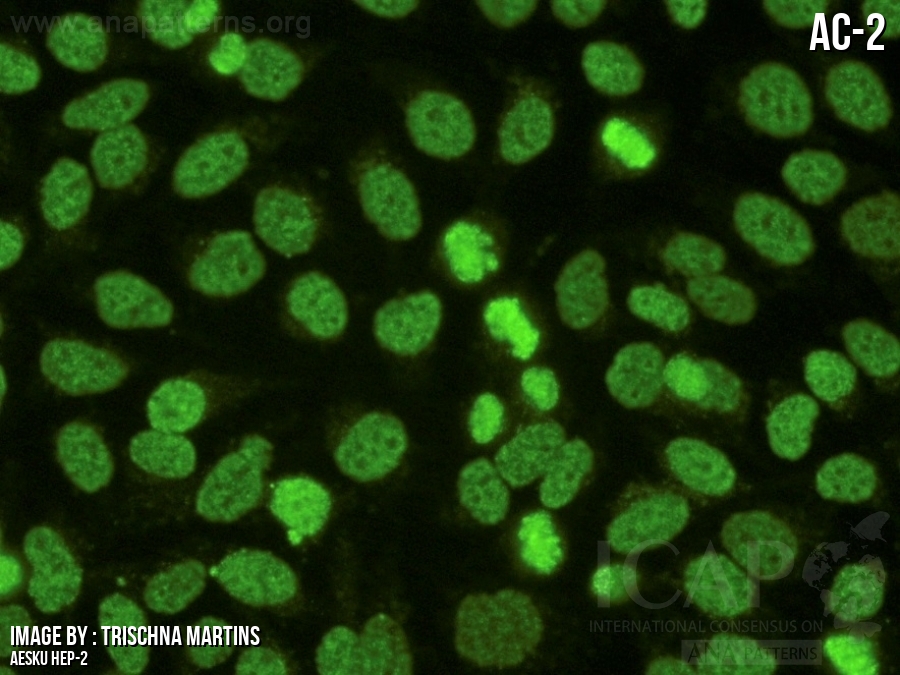
     |
|
| Previous Nomenclature | None |
| Description | The nuclear dense fine-speckled pattern is characterized by relatively small speckles that are heterogeneous in size, brightness, and density. There are fine and faint speckles, interspersed with coarser and brighter speckles, as well as some areas with a sparser distribution of speckles intermingled with more densely packed areas. Because of this heterogeneity, the periphery of the nucleus appears to be an irregular and discontinuous rim. The metaphase chromosome plate is brighter than the interphase nucleus but holds the same morphological characteristics. |
| Antigen Association | DFS70 (dense fine speckled protein of 70 kD, also known as transcription coactivator p75 and Lens Epithelium-Derived Growth Factor, LEDGF). |
|
Clinical Relevance
First level information About Clinical Relevance & List of Abbreviations |
|
▶ Commonly found as high titer HEp-2 IFA-positive in apparently healthy individuals or in patients who do not have a systemic autoimmune rheumatic disease (SARD) [1, 2] ▶ It is important to note that the bona fide AC-2 pattern is observed only when anti-DFS70 is the sole antinuclear antibody present. The presence of any additional antinuclear antibodies - such as those targeting Sm, U1-RNP, TROVE2/Ro60, dsDNA, nucleosome, histones, or Topo I - can interfere with the distinct features of the AC-2 pattern [3]. Consequently, the AC-2 pattern is generally considered to be negatively associated with these autoantibodies and, by extension, with SARD. However, it is important to note that antibodies to TRIM21/Ro52 and to Jo-1 frequently do not produce a positive result in the HEp-2 IFA test. Therefore, the negative association of AC-2 pattern and SARD holds true only when the laboratory analyst is confident in identifying the AC-2 pattern and the clinician assesses a low pre-test probability for SARD. In contrast, in clinical scenarios with a high pre-test probability of SARD, further investigation is warranted, including antigen-specific immunoassays to detect the aforementioned autoantibodies, tailored to the specific SARD under consideration. These tests are useful for identifying autoantibody reactivities that may not be detected by HEp-2 IFA and for more accurately assessing the likelihood of an underlying SARD [4-6] ▶ Both in apparently healthy individuals as well as in patients who do not have a SARD, the AC-2 pattern may rarely be attributed to autoantibodies directed to antigens other than DFS70 [3]. Prior to the recent new classification of AC-30 as a separate pattern differentiating from AC-2 [7], there were reports of AC-2-like pattern in sera without anti-DFS70 [8, 9]; most probably, many of those should be re-classified as AC-30 ▶ For optimal clinical relevance the AC-2 pattern should be distinguished from the AC-30 pattern, as these are closely resembling patterns that have different clinical significance [7, 10] |
| Second level information |
|
None |
| References |
|
1. Mariz HA, Sato EI, Barbosa SH, Rodrigues SH, Dellavance A, Andrade LE. Pattern on the antinuclear antibody-HEp-2 test is a critical parameter for discriminating antinuclear antibody-positive healthy individuals and patients with autoimmune rheumatic diseases. Arthritis Rheum. 2011;63:191-200 2. Dinse GE, Zheng B, Co CA, Parks CG, Weinberg CR, Miller FW, Chan EKL. Anti-dense fine speckled 70 (DFS70) autoantibodies: correlates and increasing prevalence in the United States. Front Immunol. 2023;14:1186439 3. Dellavance A, Baldo DC, Zheng B, Mora RA, Fritzler MJ, Hiepe F, Ronnelid J, Satoh M, et al. Establishment of an international autoantibody reference standard for human anti-DFS70 antibodies: proof-of-concept study for a novel Megapool strategy by pooling individual specific sera. Clin Chem Lab Med. 2019;57:1754-63 4. Watanabe A, Kodera M, Sugiura K, Usuda T, Tan EM, Takasaki Y, Tomita Y, Muro Y. Anti-DFS70 antibodies in 597 healthy hospital workers. Arthritis Rheum. 2004;50:892-900 5. Mahler M, Fritzler MJ. The clinical significance of the dense fine speckled immunofluorescence pattern on HEp-2 cells for the diagnosis of systemic autoimmune diseases. Clin Dev Immunol. 2012;2012:494356 6. Sanchez-Hernandez ES, Ortiz-Hernandez GL, Ochoa PT, Reeves M, Bizzaro N, Andrade LEC, Mahler M, Casiano CA. The Nuclear Dense Fine Speckled (DFS) Immunofluorescence Pattern: Not All Roads Lead to DFS70/LEDGFp75. Diagnostics (Basel). 2023;13 7. Andrade LEC, Klotz W, Herold M, Musset L, Damoiseaux J, Infantino M, Carballo OG, Choi M, et al. Reflecting on a decade of the international consensus on ANA patterns (ICAP): Accomplishments and challenges from the perspective of the 7th ICAP workshop. Autoimmun Rev. 2024;23:103608 8. Ochs RL, Mahler M, Basu A, Rios-Colon L, Sanchez TW, Andrade LE, Fritzler MJ, Casiano CA. The significance of autoantibodies to DFS70/LEDGFp75 in health and disease: integrating basic science with clinical understanding. Clin Exp Med. 2016;16:273-93 9. Bizzaro N, Tonutti E, Tampoia M, Infantino M, Cucchiaro F, Pesente F, Morozzi G, Fabris M, et al. Specific chemoluminescence and immunoasdorption tests for anti-DFS70 antibodies avoid false positive results by indirect immunofluorescence. Clin Chim Acta. 2015;451:271-7 10. Durmus MA, Komec S. Frequency of the AC-2 pattern's new variant (AC-30) and detection of different immunological relationships. Clin Immunol. 2025;278:110536 |
| FAQ |
|
9 - The pseudo-DFS pattern? Some samples yield a nuclear speckled pattern with similar staining at the mitotic chromatin (metaphase and anaphase), very similar to AC-2 (nuclear dense fine speckled pattern), but do not yield a positive result in immunoassays specific for anti-DFS70 antibodies. How should I report such pattern since it is not exactly the AC-2 pattern and there is no anti-DFS70 reactivity? Is this pattern defined by ICAP? |